Those interested in Cromwell or the Interregnum will appreciate the article Putting the Protector Back Into the Protectorate in the BBC History Magazine. It asserts that, contrary to current prevailing opinion, Cromwell the Protector took a leading role in decision making and was more than a Parliamentary figurehead. Latest research shows that while there may be little to indicate that Cromwell asserted his opinion on most decisions, the conclusion usually went his way in the end.
The article is an advert for the book, The Cromwellian Protectorate by Patrick Little, £45.
(I hope readers don't mind me posting something not directly related to Stockport, but Stockport's famous son, John Bradshaw, was one of the politicians that Cromwell variously competed an cooperated with.)
Perhaps more relevant to current Stockpor heritage issues, is the article The Workhouse: Pauper Paradise or Hell?. Many of the article's examples relate to rural workhouses, which are rather different to Stockport's St Thomas workhouse. For example, the article notes that by 1840s rural employment had risen, making the previous decade's investment in facilities for the (fit) unemployed largely obsolete. Meanwhile, slumps in the cotton industry, meant high levels of unemployment in 1840's Stockport, leading to riots outside the Stockport Workhouse and elsewhere.
Workhouses did off education, to allow the children to avoid the errors of their parents, but there was concern over teaching too much. In Norfolk, for example, guardians objected to maps in the classroom as they might encourage emmigration and reduce the labour available at harvest time. So workhouses could be used to ensure the availability of cheap labour, at the expense of better opportunities for the workers elsewhere.
One area of success for many workhouses, including Stockport's workhouse, was as hospitals. Even today, the majority of surviving workhouse sites are still used by hospitals. Initially, nursing was largely done by the workhouse matron assisted by pauper nurses who had little or no training and who were often illiterate. Overtime conditions improved so that by the end of the 19th century, people would voluntarily enter the workhouse infirmary, sometimes in preference to the local private infirmary. In some workhouse infirmaries "ordinary infirm" cases had been driven out to make room for paying patients.
Like me, the article recommends www.workhouses.org.uk for further reading. The following museums are open to the public: Gressenhall Farm & Workhouse, E Dereham; The Workhouse Museum, Ripon; The Workhouse, Southwell; & Workhouse Museum, Derry.
To see all the postings on Stockport's St Thomas Workhouse, click on the label 'Workhouse' below.
Showing posts with label Workhouse. Show all posts
Showing posts with label Workhouse. Show all posts
Sunday, January 28, 2007
Friday, June 16, 2006
St. Thomas' Workhouse Viewing

On Monday June 14th, Jason Challenger very kindly took time out of his busy schedule, as Stockport College's Property Manager, to take three Trust members around the St. Thomas' Workhouse site.

The Building facing the car park, where families were split when they entered the workhouse, has many original features including a grand staircase.
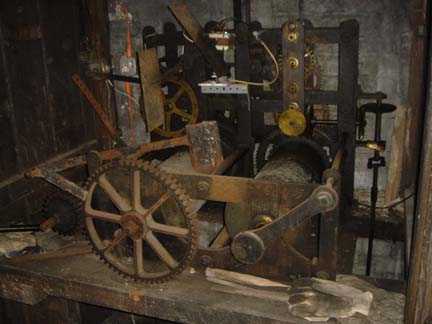
The clock mechanism, although a little dirty is complete and could be made to work again. Although hand winding may not be practical for the College.

Angela Kenrick and Jason Challenger discuss the ins and out of putting a heritage display in the clock room, for they students to learn about the site's history.
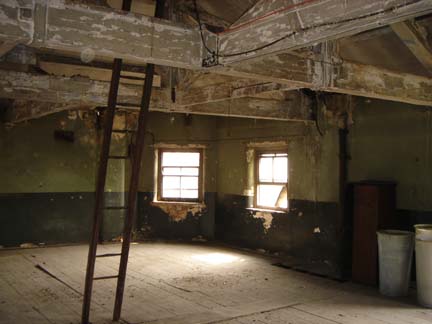
The roof has now been made water tight, and the College are preparing to put their plans for the site before English Heritage at the beginning of July. Two of our members have been invited along to this meeting to support the college in its plans to save the two oldest buildings on the site and connect them with the area of new development.
For more about the site's history see St Thomas Workhouse history
For proposals of the site, see Strategy Proposal.


Wednesday, April 26, 2006
St Thomas Hospital/Workhouse development
Stockport College have put their proposals for the development of the St Thomas Hospital (which includes the original workhouse buildings) on the 'Net. Click on the image below. They are in the form large PowerPoint files and would need broadband to download.
Slide 13 reads as follows:
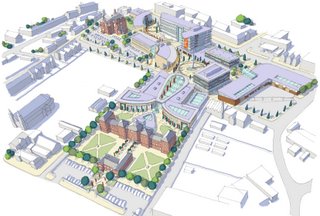 "The St. Thomas’ Hospital site is a historic complex of buildings and an important part of Stockport’s past. However, the condition of many of the buildings is extremely poor and the most important listed building, the Workhouse, is in a particularly poor condition. The College has assessed the quality and the condition of the various buildings and explored how it can most effectively bring about investment to enable the restoration and positive reuse of some of the key buildings, in line with the overall masterplan. The College has to bear in mind the sustainability of the various buildings for educational use and the need to create a sufficient stock of large floorplate buildings to provide efficient and flexible accommodation now and in the future. "Taking all these considerations into account it is not considered viable for the College to refurbish and retain all of the buildings on the site. Instead a strategy has been provided which allows for selective demolition and allows for significant investment to be concentrated on preserving the most important buildings, with selective demolition of others. The Workhouse and the Waiting Room are considered to be the most important historic assets on the site, and their refurbishment and reuse is proposed. Unfortunately, they are also the buildings in worst condition - especially the Workhouse, which has been extremely neglected and in a very poor state of repair. The buildings proposed for retention will be costly to refurbish - estimated at over £7 million. Nevertheless, given their conservation significance the College proposes to retain the Workhouse together with the Waiting Room. The masterplan proposals represent a major opportunity to secure a long term, viable future for these fine buildings. "Demolition of some of the listed buildings is therefore an essential aspect of achieving the overall development. The acceptability of the proposals will be demonstrated through the detailed stages of obtaining planning permission and listed building consent, in line with PPG15 ‘Planning and the Historic Environment."
Slide 13 reads as follows:
 "The St. Thomas’ Hospital site is a historic complex of buildings and an important part of Stockport’s past. However, the condition of many of the buildings is extremely poor and the most important listed building, the Workhouse, is in a particularly poor condition. The College has assessed the quality and the condition of the various buildings and explored how it can most effectively bring about investment to enable the restoration and positive reuse of some of the key buildings, in line with the overall masterplan. The College has to bear in mind the sustainability of the various buildings for educational use and the need to create a sufficient stock of large floorplate buildings to provide efficient and flexible accommodation now and in the future. "Taking all these considerations into account it is not considered viable for the College to refurbish and retain all of the buildings on the site. Instead a strategy has been provided which allows for selective demolition and allows for significant investment to be concentrated on preserving the most important buildings, with selective demolition of others. The Workhouse and the Waiting Room are considered to be the most important historic assets on the site, and their refurbishment and reuse is proposed. Unfortunately, they are also the buildings in worst condition - especially the Workhouse, which has been extremely neglected and in a very poor state of repair. The buildings proposed for retention will be costly to refurbish - estimated at over £7 million. Nevertheless, given their conservation significance the College proposes to retain the Workhouse together with the Waiting Room. The masterplan proposals represent a major opportunity to secure a long term, viable future for these fine buildings. "Demolition of some of the listed buildings is therefore an essential aspect of achieving the overall development. The acceptability of the proposals will be demonstrated through the detailed stages of obtaining planning permission and listed building consent, in line with PPG15 ‘Planning and the Historic Environment."
Sunday, February 26, 2006
New photos of St Thomas Workhouse

More photo's of Stockport Workhouse/St Thomas Hospital have been added to Peter Higginbottom's Workhouse website. The website is well worth a visit.May be the Trust should try to organise a visit to the site while the buildings still exists?
For previous posts see: Proposed use of St Thomas workhouse and Multi-million scheme for education unveiled
Thursday, February 16, 2006
Proposed use of St. Thomas' Workhouse
The Secretary of the Trust, Steve Cliffe, has sent this comment on the proposed use of the St. Thomas' Workhouse buildings, as part of an expansion to Stockport College.
The College are consulting stakeholder partners in Stockport for views before submitting detailed planning proposals to the Council.

"Thank you for letting me comment on the Stockport College Masterplan. Stockport Heritage Trust warmly welcome the opportunity to conserve and use the best of the listed buildings on the Old St. Thomas' Workhouse site as part of the college expansion plans. This is an idea we have favoured for many years.
The two most important buildings are the Master and Matron's House (clocktower building) and the entrance lodge which both have fine classical Georgian lines and link to key historic events of the early 19th C. Which were covered by the artist of the London Illustrated News.
I do feel that page 12 of your document is vague and possibly deliberately ambiguous in committing the college to preserving any listed building and deserves to have been thoroughly proofread!
Also we question whether orienting the main gateway access from the A6 is the wisest option where an anterior approach via Greek Street might prove a more amenable space and safer traffic free access to and from the town centre. But this is something the Council's Regeneration team needs to address.
Broadly we support Option 4 and its speedy implementation in order to preserve and utilise the deteriorating important listed structures."
The College are consulting stakeholder partners in Stockport for views before submitting detailed planning proposals to the Council.

"Thank you for letting me comment on the Stockport College Masterplan. Stockport Heritage Trust warmly welcome the opportunity to conserve and use the best of the listed buildings on the Old St. Thomas' Workhouse site as part of the college expansion plans. This is an idea we have favoured for many years.
The two most important buildings are the Master and Matron's House (clocktower building) and the entrance lodge which both have fine classical Georgian lines and link to key historic events of the early 19th C. Which were covered by the artist of the London Illustrated News.
I do feel that page 12 of your document is vague and possibly deliberately ambiguous in committing the college to preserving any listed building and deserves to have been thoroughly proofread!
Also we question whether orienting the main gateway access from the A6 is the wisest option where an anterior approach via Greek Street might prove a more amenable space and safer traffic free access to and from the town centre. But this is something the Council's Regeneration team needs to address.
Broadly we support Option 4 and its speedy implementation in order to preserve and utilise the deteriorating important listed structures."
Wednesday, February 01, 2006
Guided tour of St Thomas

St. Thomas (C of E), Wellington Road South was founded in 1825 as a chapel to St. Mary, becoming the parish church for Bramhall and parts of Stockport and Stockport Etchells in 1827.

 The Rev. Ken Kenrick gave us an excellent tour of the church, with fascinating historical information. It is a very impressive church and once must have been a very impressive civic statement, when Hillgate was still the main thoroughfare into Stockport.
 Inside the paintwork needs attention, but at least the most urgent repairs are getting attention. The tower is being repaired, with most of the money coming from English Heritage but £19,000 still had to be raised by the church.
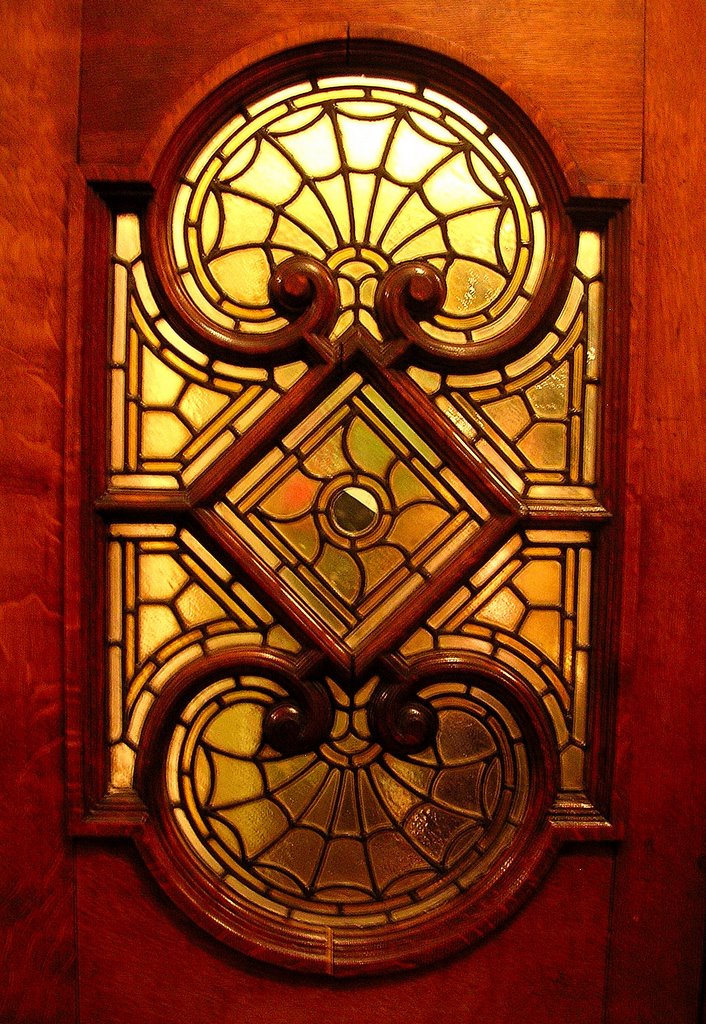 Amongst the fascinating historical trivia Ken told us, was that he is still the official St Thomas Workhouse chaplin and paid for the post, though the work house was done away with long ago. (Though the payment is deducted from his salary as rector of St Thomas and St Peters.)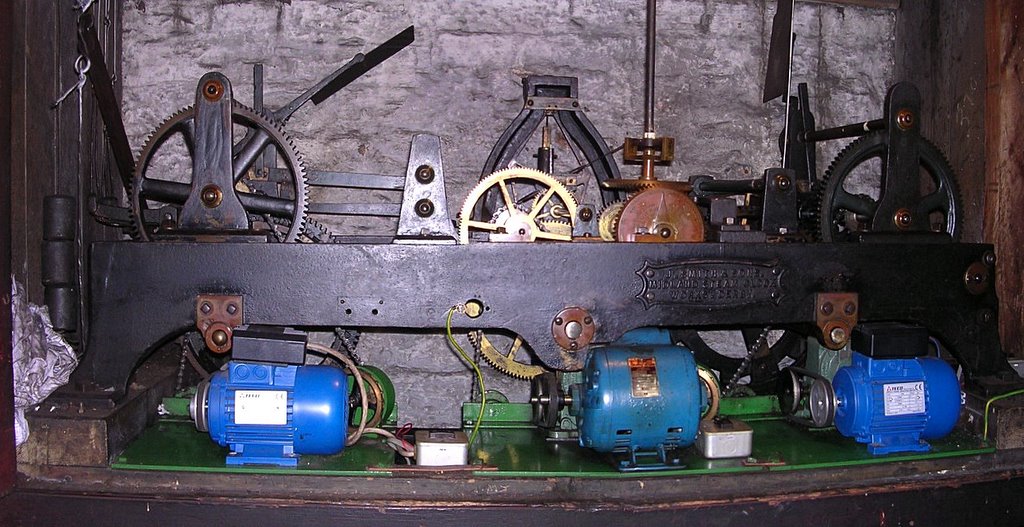
The clock mechanism states "J. Smith & Sons. Midland Steam Clock Works. Derby"
Subscribe to:
Posts (Atom)